> For the complete documentation index, see [llms.txt](https://docs.portainer.io/llms.txt). Markdown versions of documentation pages are available by appending `.md` to page URLs; this page is available as [Markdown](https://docs.portainer.io/user/kubernetes/applications/webhooks.md).
# Webhooks
A webhook is a POST request sent to a URL. Use webhooks to trigger an action in response to an event such as a repository push.
{% hint style="info" %}
This functionality is only available in [Portainer Business Edition](https://www.portainer.io/business-upsell?from=stack-webhook).
{% endhint %}
{% hint style="info" %}
Webhooks are only available on non-Edge environments (environments running Portainer Server or Portainer Agent, not the Portainer Edge Agent). This is because the tunnel to the Portainer Edge Agent is only opened on-demand, and therefore would mean there is no way to expose a webhook permanently.
{% endhint %}
## Enabling an application webhook
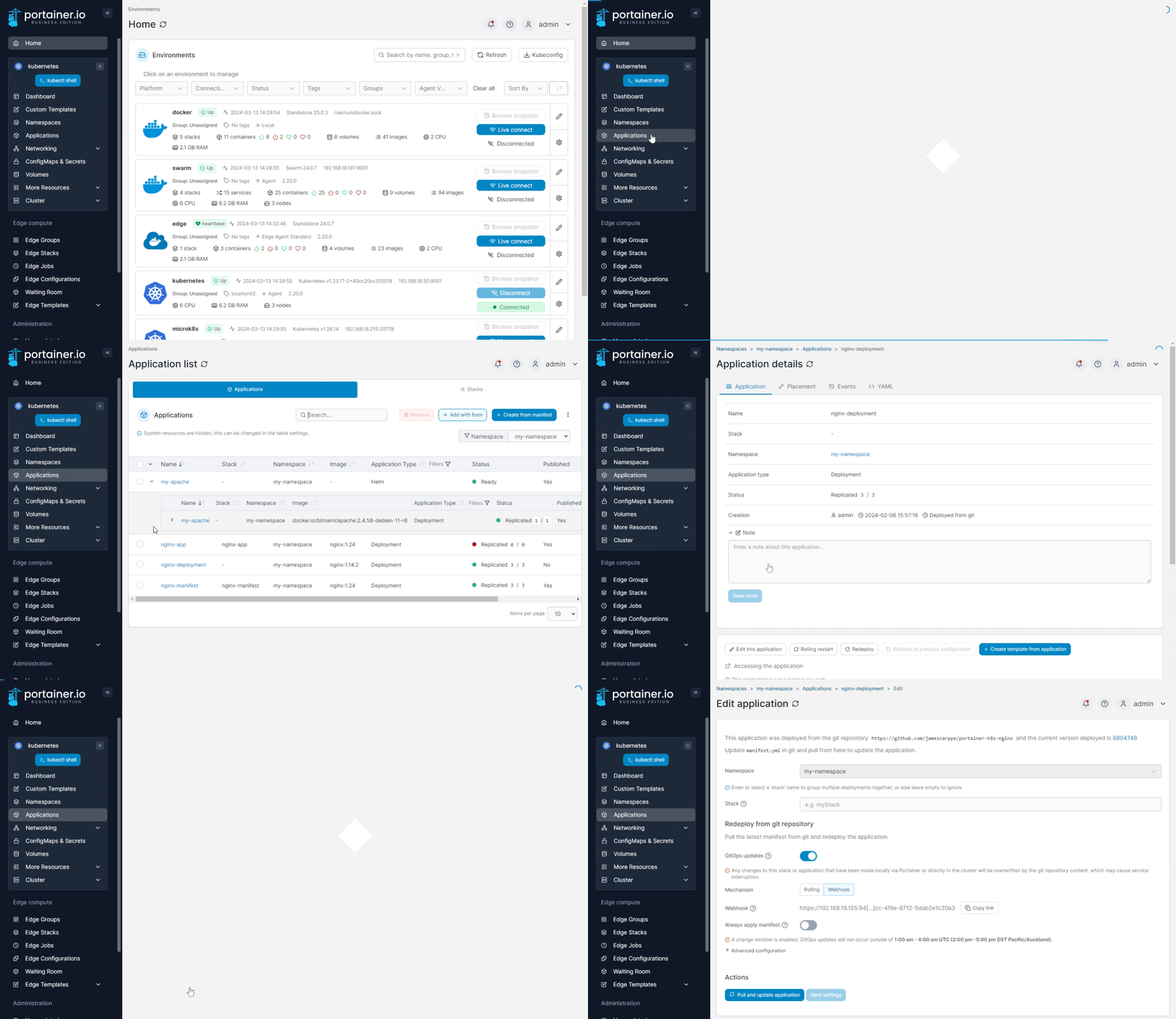
From the menu select **Applications** then select the application that you want to configure the webhook for. Then select the **Edit this application** button.
{% hint style="info" %}
Webhooks are only available for applications deployed from a Git repository.
{% endhint %}
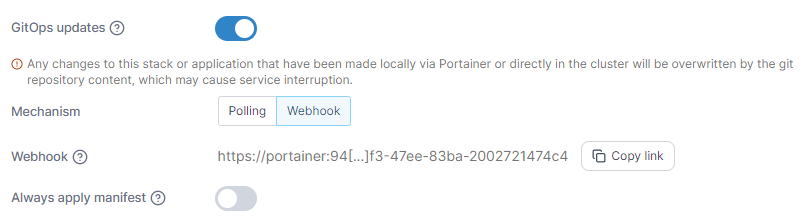
Enable **GitOps updates** if it is not already enabled and select `Webhook` as the **Mechanism**. When the URL appears, click **Copy link**. This is the URL used to trigger the webhook.
This example shows how to trigger the webhook:
```
```
## Using environment variables with webhooks
When triggering a webhook, environment variables can be passed through the endpoint and referenced within the deployment.
{% hint style="info" %}
Environment variables can not be updated for Pods, only for Deployments.
{% endhint %}
To specify an environment variable on a webhook, add it as a variable to the URL. For example, to pass a `SERVICE_TAG` variable with the value `development`:
```
https://portainer:9443/api/stacks/webhooks/40ac1662-47c3-4a8e-b148-2a34eb52bb42?SERVICE_TAG=development
```
To reference the `SERVICE_TAG` variable in your manifest with a fallback to the value `stable`:
```
apiVersion: apps/v1
kind: Deployment
metadata:
name: nginx-deployment
spec:
selector:
matchLabels:
app: nginx
replicas: 2
template:
metadata:
labels:
app: nginx
spec:
containers:
- name: nginx
image: nginx:1.14.2
ports:
- containerPort: 80
env:
- name: SERVICE_TAG
value: "stable"
```
{% hint style="warning" %}
Environment variables must already be defined in the manifest - new environment variables cannot be added via the webhook.
{% endhint %}
## Rolling restarts
When using an application's webhook to redeploy your application, you can tell Portainer to perform a rolling restart of the application rather than a "terminate and restart" redeploy.
{% hint style="info" %}
This functionality is only available in Portainer Business Edition.
{% endhint %}
To specify this, use the `rollout-restart` parameter in your webhook call:
```
https://portainer:9443/api/stacks/webhooks/40ac1662-47c3-4a8e-b148-2a34eb52bb42?rollout-restart=all
```
Valid options are as below:
| Option | Overview |
| --------------------------------------------------------------- | --------------------------------------------------------------------------------------------------------------------------------------------------------------------------------------------------------------------------------------------------------------------------------------------------------------------------------------------------------------------------- |
| `rollout-restart=all` | All of the application's deployments will be redeployed as a rolling restart. |
| `rollout-restart=deployment/deployment1,deployment/deployment2` |
Only the specified deployment(s) will be redeployed as a rolling restart. All other deployments will not be redeployed or restarted. Separate multiple deployments with commas. This option supports Deployments (deployment/deployment1), DaemonSets (daemonset/daemonset1), and StatefulSets (statefulset/statefulset1).
|
If the `rollout-restart` parameter is not defined, the webhook will redeploy the application in traditional "terminate and restart" behavior.
{% hint style="warning" %}
If your cluster has a [change window](/user/kubernetes/cluster/setup.md#change-window-settings) enabled, the rolling restart will only be performed within the change window.
{% endhint %}