# Custom templates

A custom template can be used to help streamline the deployment of a container or stack.

{% hint style="info" %}
You can also [create a template from an existing deployed stack](https://docs.portainer.io/user/docker/stacks/template).
{% endhint %}

## Viewing the list of custom templates

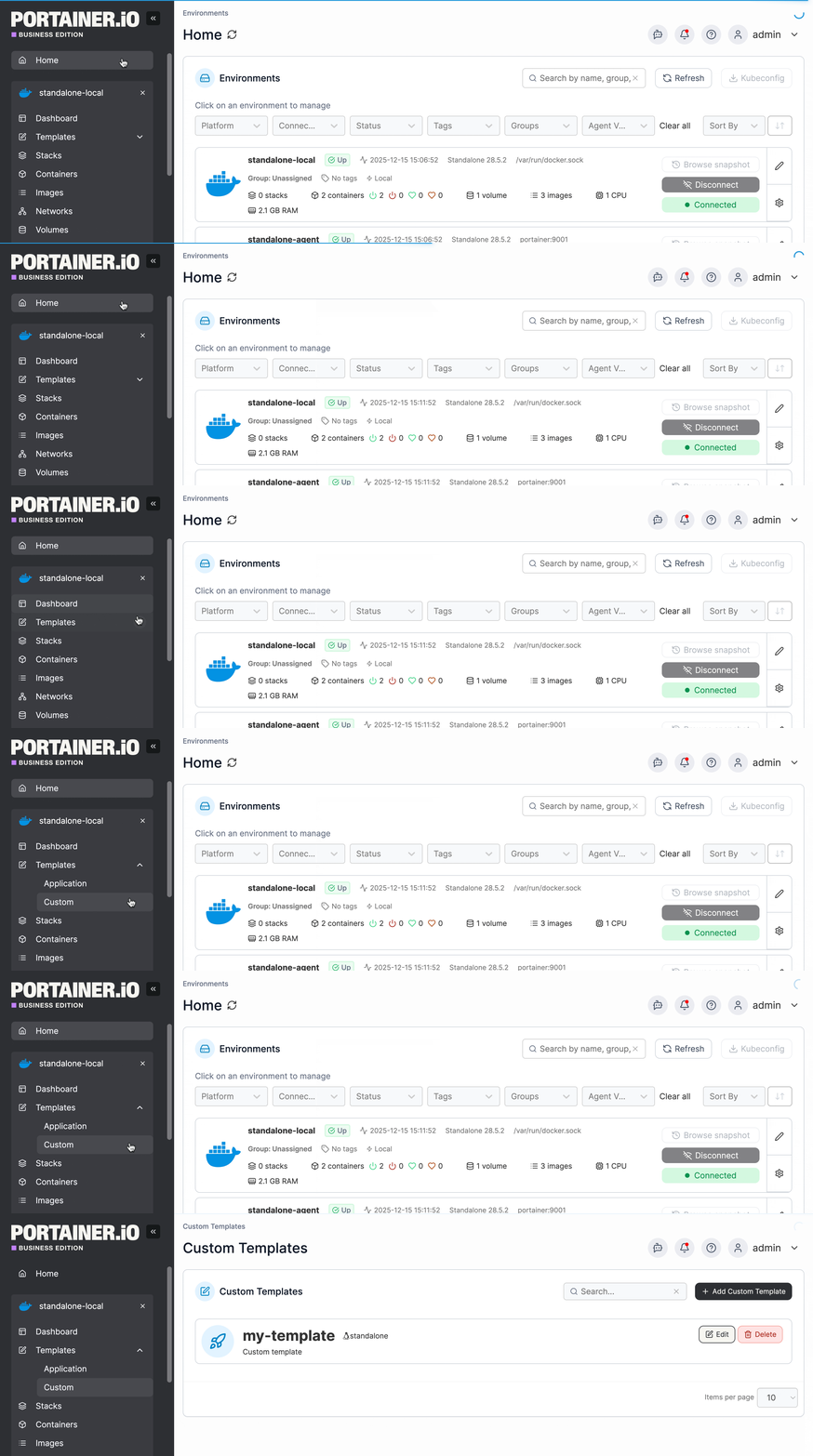
To view a list of custom templates, from the menu expand **Templates** then select **Custom**.

<figure><img src="https://content.gitbook.com/content/xdTQRpMuktD2l0URtOJO/blobs/TthGKuyX2cQgz6Bb35Ke/custom-templates-new.gif" alt=""><figcaption></figcaption></figure>

## Creating a new custom template

### Entering the basic information

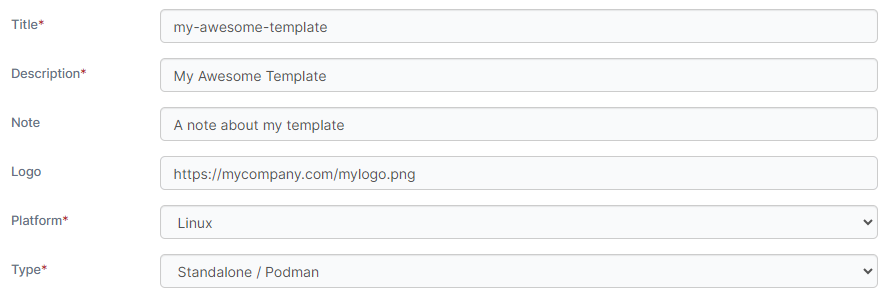
Click **Add Custom Template** then complete the details, using the table below as a guide.

| Field/Option | Overview                                                                                    |
| ------------ | ------------------------------------------------------------------------------------------- |
| Title        | Give the template a descriptive name.                                                       |
| Description  | Enter a brief description of what your template includes.                                   |
| Note         | Note any extra information about the template (optional).                                   |
| Logo         | Enter the URL to a logo to be used for the template when it appears in the list (optional). |
| Platform     | Select the compatible platform for the template. Options are **Linux** or **Windows**.      |
| Type         | Select the type of template. Options are **Standalone / Podman** or **Swarm**.              |

<figure><img src="https://content.gitbook.com/content/xdTQRpMuktD2l0URtOJO/blobs/XV1LOKmo9NbCIad0mYYb/2.22.0-templates-custom-new.png" alt=""><figcaption></figcaption></figure>

### Selecting the build method

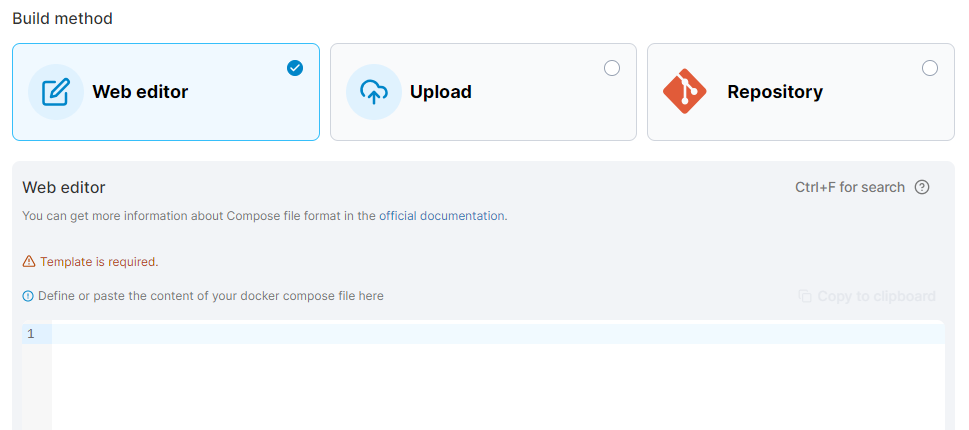
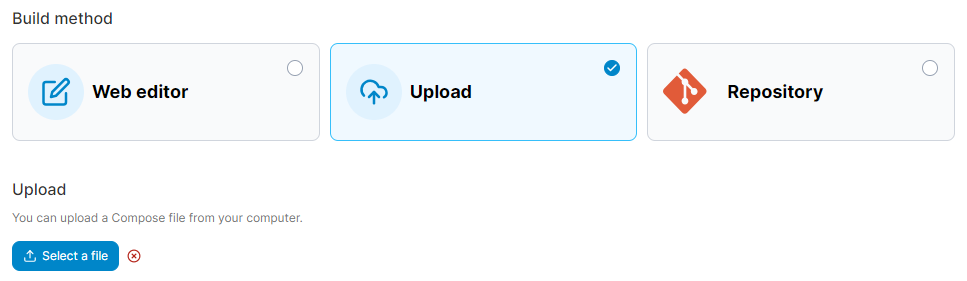
Next, choose the build method that suits your needs. You can use the web editor to manually enter your docker-compose file, upload a `docker-compose.yml` file from your local computer, or pull the compose file from a Git repository.

#### Web editor

Paste the contents of your docker-compose file into the box provided. Once all the details have been completed, click **Create custom template**.

{% hint style="info" %}
You can search within the web editor at any time by pressing `Ctrl-F` (or `Cmd-F` on Mac).
{% endhint %}

<figure><img src="https://content.gitbook.com/content/xdTQRpMuktD2l0URtOJO/blobs/LRUdPArJU3kHv1WlYoF5/2.20-templates-custom-add-webeditor.png" alt=""><figcaption></figcaption></figure>

#### Upload

Click **Select file** to browse for a docker-compose file to upload. Once all the details have been completed, click **Create custom template**.

<figure><img src="https://content.gitbook.com/content/xdTQRpMuktD2l0URtOJO/blobs/ZSGIoUhpPtvKUFJRfQ3S/2.20-templates-custom-add-upload.png" alt=""><figcaption></figcaption></figure>

#### Git repository

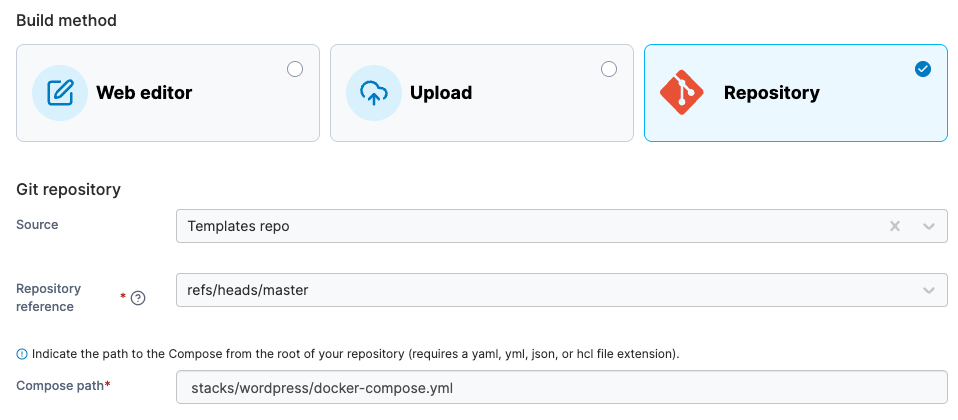
Fill in the details for your Git repository.

| Field/Option          | Overview                                                                                                                                                                                                                                                                                                                                                                                                                                              |
| --------------------- | ----------------------------------------------------------------------------------------------------------------------------------------------------------------------------------------------------------------------------------------------------------------------------------------------------------------------------------------------------------------------------------------------------------------------------------------------------- |
| Authentication        | Enable this if your Git repository requires authentication.                                                                                                                                                                                                                                                                                                                                                                                           |
| Git Credentials       | If the **Authentication** toggle is enabled and you have configured [individual](https://docs.portainer.io/account-settings#git-credentials) or [shared](https://docs.portainer.io/admin/settings/credentials/git) Git credentials, you can select them from this dropdown. Shared Git credentials can be identified with the **Shared** tag, and are only available to administrators at present. Leave this field unset to provide new credentials. |
| Username              | When Authentication is enabled, enter your Git username.                                                                                                                                                                                                                                                                                                                                                                                              |
| Personal Access Token | <p>When Authentication is enabled, enter your personal access token or password.<br>Ensure your token has repository read permissions. See the <a href="../../../faqs/getting-started/what-scopes-are-required-for-github-gitlab-and-bitbucket-tokens">Git authentication token permissions FAQ</a>.</p>                                                                                                                                              |
| Save credential       | When Authentication is enabled and you have provided new credentials, you can tick this box and enter a name to save those credentials for future use.                                                                                                                                                                                                                                                                                                |
| Repository URL        | Enter the URL to your Git repository.                                                                                                                                                                                                                                                                                                                                                                                                                 |
| Repository reference  | Select the repository reference to define the branch or tag to pull from.                                                                                                                                                                                                                                                                                                                                                                             |
| Compose path          | Enter the path within the repository to your docker-compose file.                                                                                                                                                                                                                                                                                                                                                                                     |
| Skip TLS Verification | Enable this option to skip verification of your Git repository's TLS certificate.                                                                                                                                                                                                                                                                                                                                                                     |

<figure><img src="https://content.gitbook.com/content/xdTQRpMuktD2l0URtOJO/blobs/tdB0z8SjWC9UJC0KCyYO/2.20-templates-custom-add-git.png" alt=""><figcaption></figcaption></figure>

When all the details have been entered, click **Create custom template**.

## Variables in templates

Custom templates support the use of variables to provide further customization of the deployed stack. A stack can define a variable that can then be adjusted by the user at deployment.

{% hint style="info" %}
This feature is only available in Portainer Business Edition.
{% endhint %}

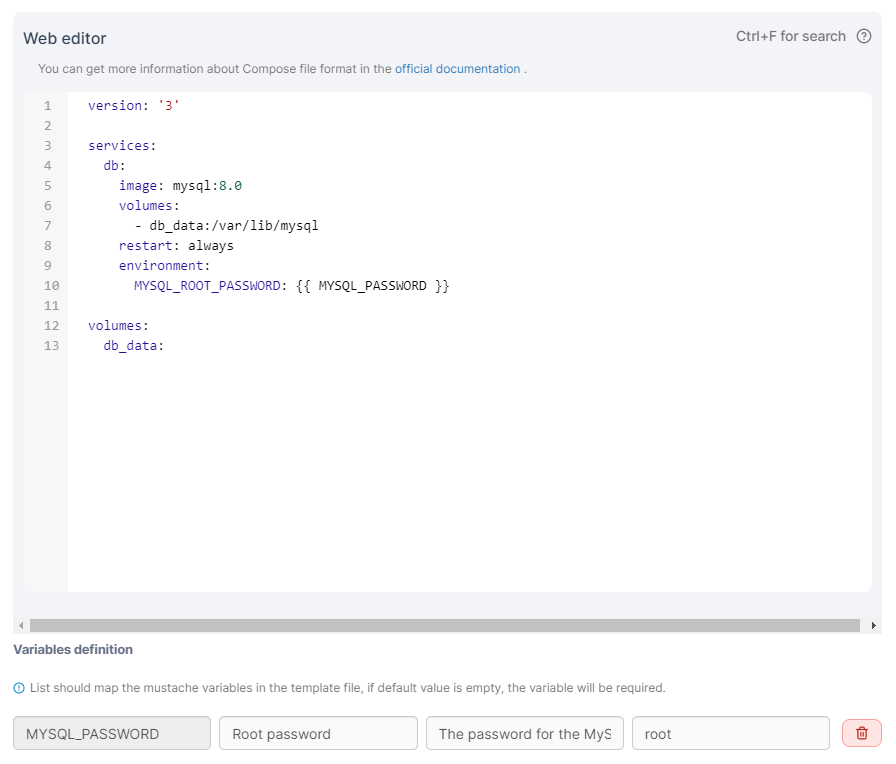
Variables are identified in stacks with `{{ }}`. For example, the following stack provides a `MYSQL_PASSWORD` variable:

<figure><img src="https://content.gitbook.com/content/xdTQRpMuktD2l0URtOJO/blobs/eAA0K1vWESbWoyIXsx2g/2.15-docker-templates-custom-variables-set.png" alt=""><figcaption></figcaption></figure>

When a variable is defined, options appear to customize how the variable appears when deploying the stack. You can set the **label**, **description** and **default value**.

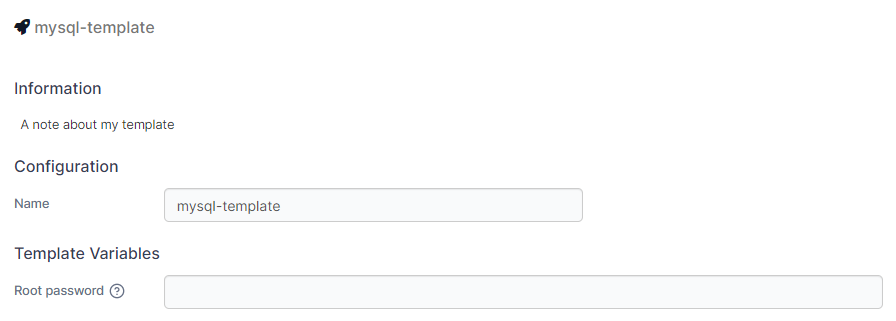
When a template is deployed, any variables that have been configured are editable:
<figure><img src="https://content.gitbook.com/content/xdTQRpMuktD2l0URtOJO/blobs/A3xvQWiDSo5hp94fI936/2.15-docker-templates-custom-variables-create.png" alt=""><figcaption></figcaption></figure>