> For the complete documentation index, see [llms.txt](https://docs.portainer.io/llms.txt). Markdown versions of documentation pages are available by appending `.md` to page URLs; this page is available as [Markdown](https://docs.portainer.io/user/docker/stacks/migrate.md).
# Migrate, duplicate or rename a stack
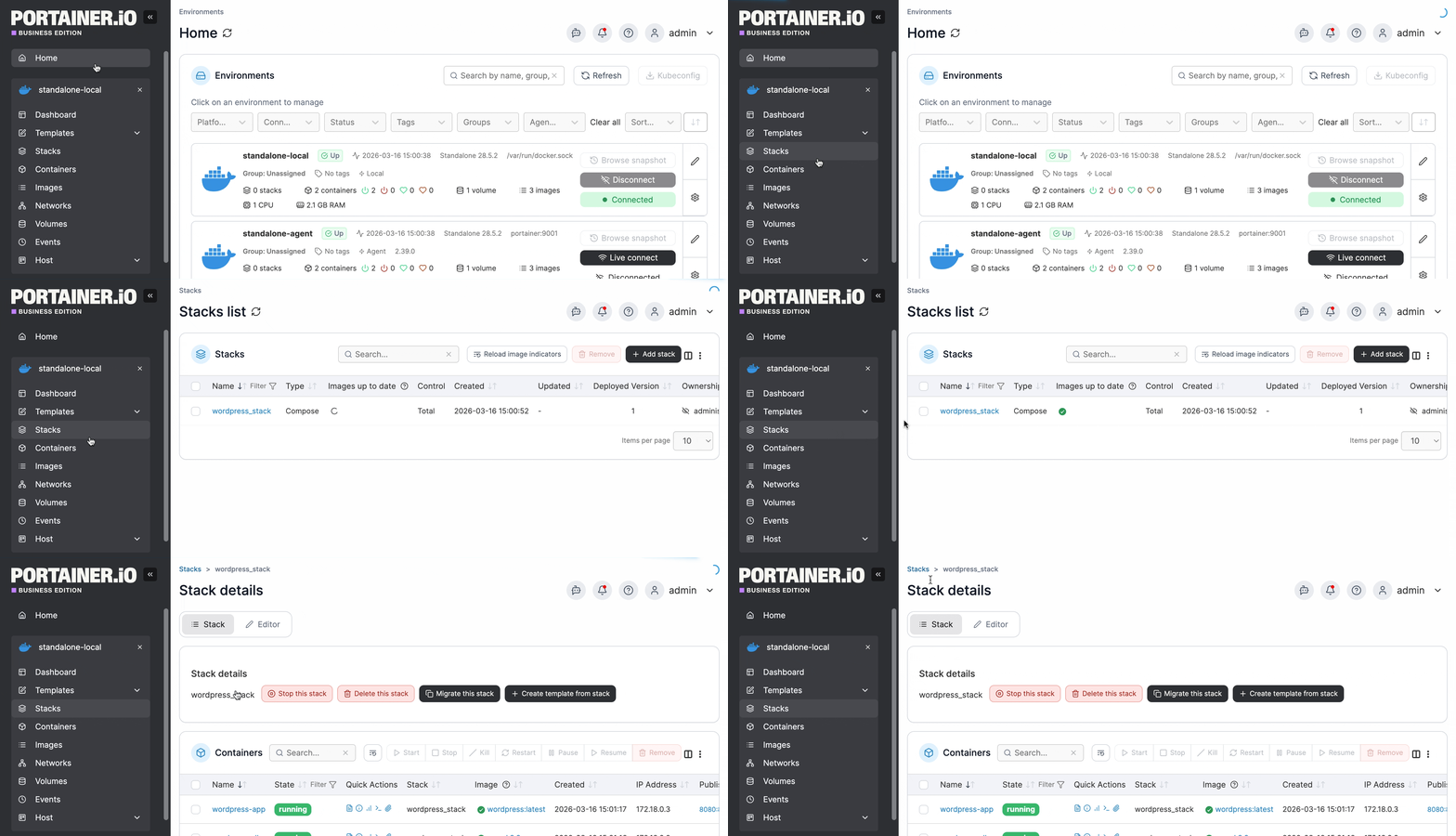
To migrate, duplicate, or rename a stack, open your environment, go to **Stacks**, and select the stack you want to change.
## Migrating a stack
### Docker Compose to Kubernetes migration
{% hint style="warning" %}
Migrating Docker stacks to Kubernetes is currently an experimental feature and is not recommended for production workloads.
Before starting the migration, we recommend [taking a backup](/admin/settings/general.md#back-up-portainer).
{% endhint %}
Portainer allows you to migrate your Docker Compose workloads to Kubernetes. This feature uses the [Kompose](https://kompose.io/) tool to convert Docker Compose definitions into Kubernetes resources.
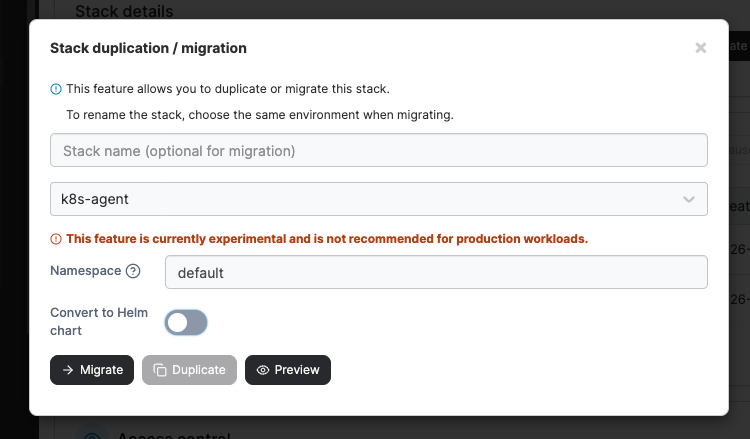
From the stack you want to migrate, select **Migrate this stack**. In the dialog box that appears, select your Kubernetes environment as the destination for the migration, then complete the fields as described below. Click **Migrate**.
| Field | Overview |
| --------------------- | ---------------------------------------------------------------------------------------------------------------------------------------------------------------------- |
| Namespace | Specify the [namespace](/user/kubernetes/namespaces.md) you wish to migrate to. If the namespace you enter does not exist, a new one will be created during migration. |
| Convert to Helm chart | Toggle this on to convert your stack to a Helm chart. Note that if migrating to a Helm chart, the preview function will no longer be an option. |
### Migration between Docker environments
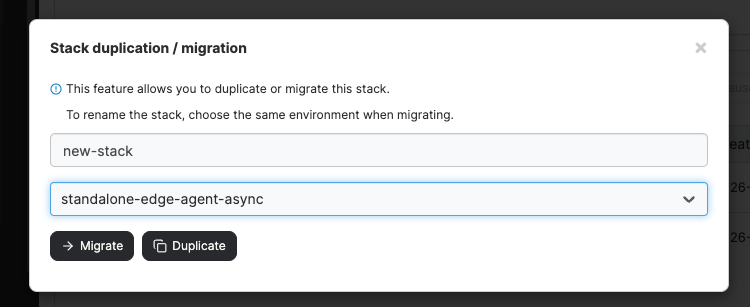
From the stack you want to migrate, select **Migrate this stack**. Select the destination environment for the stack, and optionally define a new name for the stack. Click **Migrate**.
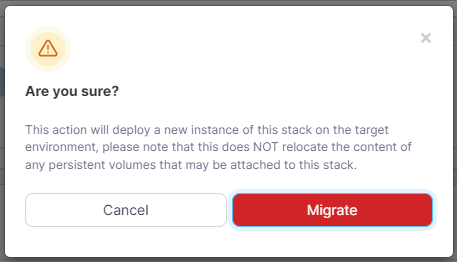
Migrating does not relocate the content of any persistent volumes that may be attached to the stack. Acknowledge this warning and confirm the migration by clicking **Migrate**.
## Duplicating a stack
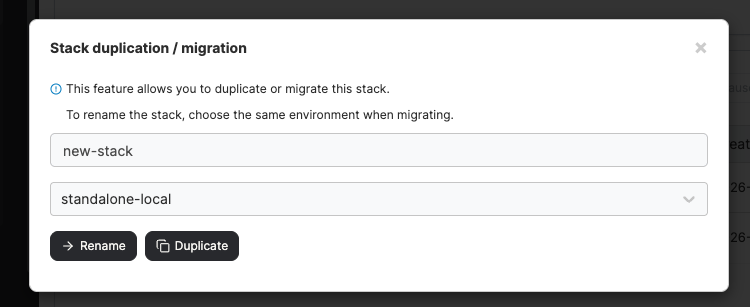
From the stack you want to duplicate, select **Migrate this stack**. Give the new stack a descriptive name then select the environment the stack should duplicate to. Click **Duplicate**.
## Rename a stack
From the stack you want to rename, select **Migrate this stack**. Give the stack a new descriptive name and select the environment that the stack is currently on. Click **Rename**.
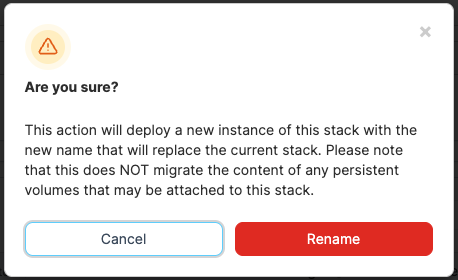
Renaming the stack creates a new stack instance and does not transfer the content of any persistent volumes that may be attached to the stack. Acknowledge this warning and confirm the migration by clicking **Rename**.